
· Study of Coelenterates is known as Cnidology
· The term Coelenterate was given by Leuckart.
· Coelenteron (Kilos + enteron); Kilos meaning cavity and enteron meaning intestine; thus coelenterates are those having a space which acts as both a cavity and an intestine (Gastrovascular cavity).
· Also called Cnidaria (the term given by Barnes).
· Cnidaria, because of the presence of Cnidoblast (Stinging cells).
· The members of this phylum are commonly called stinging animals.
VVI Examples of Phylum Coelenterata for Entrance Exams of Nepal:
- Hydra,
- Obelia (Sea fur),
- Physalia (Portuguese man of war),
- Bougainvillea
- Aurelia or Jellyfish,
- Pelogia,
- Poricolpa,
- Pilema,
- Rhizostoma
- Adamsia
- Metridium (Sea anemone)
- Edwardsia
- Pennatula (Sea pen)
- Gorgonia (Sea fan)
- Alcyonium (Dead man's finger)
Characteristics of Phylum Coelenterata
· They have a single central cavity, the coelenteron or gastrovascular cavity; having a single opening to the exterior or incomplete digestive system or blind sac body plan.· The body is radially symmetrical.
· They are aquatic, occurring in freshwater or sea, attached or freely moving; solitary or colonial.
· Diploblastic; their body wall is composed of Epidermis and Gastrodermis (with non-cellular mesoglea between them).

The life history of coelenterates illustrates the phenomenon of alternation of generations or metagenesis, in which sexual free-swimming medusoid generation alternates with asexual, sessile usually colonial, polyploid generation. Both the polyp and medusa are diploid.
· They have diffused nerve-net (brain absent). Neurons are non-polar types.
· They reproduce by external budding (asexual) and gametic fusion (sexual). The power of regeneration is also developed.
· A ciliated planula larva is formed during the development in Obelia and Ephyra in Aurelia.
· Excretion is ammonotelic; gaseous exchange and excretion by general body surface.
· Both layers of body wall and tentacles having Cnidoblast/Nematoblast i.e. stinging cells which form nematocysts secreting hypnotoxin. It is used for offence and defence.
· Sensory organs: eyespots or statocysts, olfactory pits.
· Tissue grade of body organization i.e. their cells have specialized to form tissues showing the division of labour.
· Acoelomate; blind sac body plan; the mouth is the only opening that serves for ingestion and egestion.
· Ectoderm/Epidermis has seven types of cells; epithelio-muscle cells; glandulo-muscle cells; interstitial cells, nematoblast/cnidoblast, germ cells, sensory nerve cells, and ganglion cells.
· Gastrodermis or endoderm consists of five types of cells: nutritive-muscular cells; secretory cells, sensory cells, nerve cells, and interstitial cells.
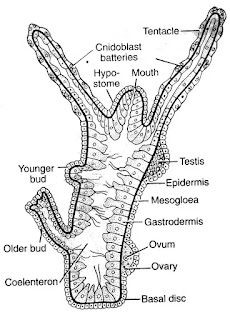 |
| L. S. of Hydra |
 |
| Different cells in Hydra |
· Interstitial cells can differentiate into any of the specialized cells and thus are totipotent cells.
· Coelenterates are carnivorous. They can digest all food except the starch.
· Extracellular digestion is followed by intracellular digestion.
· Possess tentacles around the mouth or on the margin of the body in one or two whorls.
Tentacles serve for food intake, capturing, and defence.
Tentacles may be hollow (in Hydra) or solid (in Obelia).
· The colonial coelenterates are polymorphic (polyp and medusae forms are present in the colony).
Polyps are of 3 types:
A. Dactylozooids concerned with protection),
B. Gastrozooids (responsible for feeding), and
C. Gonozooids (responsible for reproduction).
Classification of Phylum Coelenterata
On the basis of dominance of polypoid or medusoid form, the phylum Coelenterata is divided into the following three classes.1. Hydrozoa
· Hydrozoans are solitary or colonial forms.· Mostly marine, few are freshwater forms.
· Diploblastic.
· They have both Polyp and Medusa stages in their life cycles.
· Medusa has true velum i.e. it is Craspedole.
· Gonads are ectodermal in origin.
· Show metagenesis.
· They have statocysts to maintain equilibrium.
Examples: Hydra, Obelia (Sea fur), Physalia (Portuguese man of war), Bougainvillea, etc.
2. Scyphozoa (Skyphos – cup; zoon – animal)
· Solitary; marine forms and planktonic.· Triploblastic body wall.
· The polyp stage is absent or very much reduced.
· The adults are medusoid; lacking velum i.e. acraspedote; bell or umbrella-shaped.
· Gonads are endodermal in origin.
· Gametes are discharged internally
· Mesogloea is thick.
· Larva is called Ephyra.
· They have tentaculocytes to maintain equilibrium.
· This class consists of larger jellyfishes.
Examples: Aurelia or Jellyfish, Pelagia, Poricolpa, Pilema, Rhizostoma, etc.
· Aurelia is bioluminescent (emits light).
3. Anthozoa (Anthos – flower; zoon – animal)
· Solitary or colonial; marine forms.· Triploblastic body wall.
· Only the polyp stage is present in the life cycle.
· Their coelenteron is divided by the mesenteries into compartments (septate).
· The mesoglea is thick with fibrous connective tissue and amoeboid cells.
· Gonads are endodermal and develop from mesenteries.
· Reef-forming (fringing reef, Atoll reef) true stony corals belong to this class.
Examples:
- Adamsia
- Metridium (Sea anemone)
- Edwardsia
- Pennatula (Sea pen)
- Gorgonia (Sea fan)
- Alcyonium (Dead man's finger) etc.
Important Information
· Coral is secreted by the epidermis of polyp (Sea anemone, Alcyonium); as the skeleton of calcium carbonate.· The basal disc of Hydra contains zoochlorella, a unicellular green alga (Chlorella vulgaris) showing symbiotic association.
· Hydra is a solitary, fresh stagnant water polyp.
· The closed-end by which Hydra remains attached to some object is known as a foot or Basal disc (aboral).
· Another end of the body is a conical process the Hypostome or Oral cone (the most sensitive part of the body).
Types of Nematocysts
i) Penetrant or stenotele: Largest; paralyzing prey by injecting hypnotoxin. Hypnotoxin is protein and phenol.ii) Volvent or desmoneme,
iii) Large glutinant or Holotrichous isorhiza,
iv) Small glutinant or Atrichous isorhiza.
· A group of nematocysts is called cnidom.
· Trigger needle of cnidoblast is called cnidocil that discharges in 0.3 to 0.5 seconds.
· Locomotion is brought about by myoepithelial cells.
· Solid gastrula during development is called stereogastrula.
· Regeneration i.e. formation of new tissues to replace which has been lost is seen in Hydra; 1st discovered by Trembly (discovered Hydra first)
Also, Read our Other Notes Important for Entrance Exams:
- Phylum Protozoa
- Leishmania donovani
- Amoeba proteus
- Phylum Porifera
- Phylum Coelenterata
- Hydra
- Phylum Ctenophora
- Phylum Platyhelminthes
- Liver fluke
- Tapeworm
- Phylum Nemathelminthes
- Ascaris lumbricoides (Roundworm)
- Wucheria bancrofti (Filarial worm)
- Ancylostoma (Hookworm)
- Enterobius (Pinworm)
- Phylum Annelida
- Earthworm
- Phylum Arthropoda
- Cockroach
- Mosquito
- Phylum Mollusca
- Phylum Echinodermata
- Phylum Chordata
Comments
Post a Comment