
Classification
Kingdom: ProtistaPhylum: Protozoa
Subphylum: Ciliophora
Class: Ciliata
Genus: Paramecium
Species: caudatum
· The term Paramecium was coined by John Hill (1752 AD).
· Body is slipper-like so-called slipper animalcule.
A. Habitat
· Found in freshwater where there are decaying vegetables and animal remains.
· They are infusorians, a ciliated protozoan.
B. Habit
· Locomotion by cilia.
· Holozoic nutrition
· Respiration through the general body surface.
· Excretion partly by general body surface and partly by contractile vacuoles, ammonotelic.
· Osmoregulation is controlled by contractile vacuoles only.
· Reproduction asexual as well as sexual, asexual reproduction by binary fission, sexual reproduction by conjugation.
C. Structure
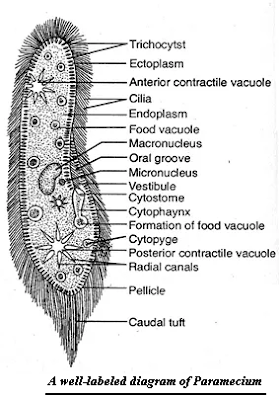
· Shape somewhat like the sole of a slipper so-called slipper animalcule.
· Streamlined type of body anterior end is blunt and semicircular while posterior end is pointed.
· Asymmetrical, ventral flat oral side and dorsal convex aboral side.
· Definite shape due to presence of outer covering, pellicle.
· Pellicle is formed by gelatin.
D. Feeding Apparatus
· Oral groove or buccal groove lies in 1/3rd position of the anterior end of the ventral side as a large depression.
· Oral groove leads into the vestibule which further leads into mouth or cytostome and then gullet (cytopharynx) which passes into endoplasm forming a food vacuole.
· Oral groove, vestibule, cytostome and cytopharynx together are known as feeding apparatus of Paramecium.
· Body is slipper-like so-called slipper animalcule.
A. Habitat
· Found in freshwater where there are decaying vegetables and animal remains.
· They are infusorians, a ciliated protozoan.
· Locomotion by cilia.
· Holozoic nutrition
· Respiration through the general body surface.
· Excretion partly by general body surface and partly by contractile vacuoles, ammonotelic.
· Osmoregulation is controlled by contractile vacuoles only.
· Reproduction asexual as well as sexual, asexual reproduction by binary fission, sexual reproduction by conjugation.
C. Structure
· Shape somewhat like the sole of a slipper so-called slipper animalcule.
· Streamlined type of body anterior end is blunt and semicircular while posterior end is pointed.
· Asymmetrical, ventral flat oral side and dorsal convex aboral side.
· Definite shape due to presence of outer covering, pellicle.
· Pellicle is formed by gelatin.
· Oral groove or buccal groove lies in 1/3rd position of the anterior end of the ventral side as a large depression.
· Oral groove leads into the vestibule which further leads into mouth or cytostome and then gullet (cytopharynx) which passes into endoplasm forming a food vacuole.
· Oral groove, vestibule, cytostome and cytopharynx together are known as feeding apparatus of Paramecium.
E. Cytopyge
· On the oral or ventral surface just behind the mouth, there is a pore called cell anus or cytopyge or cytoproct through which undigested food passes out.
F. Cilia
· The whole body is regularly covered with cilia which help in locomotion and food capture.
· Caudal end has large, compactly arranged cilia called caudal tuft so the species name is given caudatum.
· Each cilium arises from a basal granule or kinetosome located in the ectoplasm.
· Cilia have a 9+2 arrangement and they also act as sensory receptors which detect the stimuli of the external environment.
· Cilia show synchronous (simultaneous, in transverse rows) and metachronous) (successive, in longitudinal rows) beating regulated by the neuromotor system and infraciliary system.
· Pellicle binds the cytoplasm which is distinguished into ectoplasm and endoplasm.
· Trichocyst is situated in the ectoplasm perpendicularly to the body surface which takes part in offence, defence and attachment.
· Trichocyst is divisible into three parts: cap, shaft and spike. The shaft contains trichinin chemical.
· Discharged trichocyst is 10 times longer than undischarged trichocyst.
· Endoplasm shows streaming movement which is called cyclosis.
· Endoplasm contains food vacuoles, two contractile vacuoles, two nuclei; one macro and another micronucleus (Heterokaryatic organism)
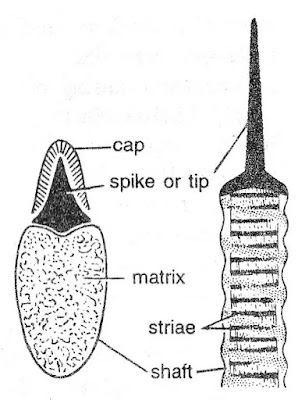 |
| A B Trichocyst, A – undischarged, B – discharged |
Differences Between Macronucleus and Micronucleus
| Macronucleus | Micronucleus |
|---|---|
| • Large in size | • Small in size considerably |
| • Kidney-shaped | • Round |
| • No definite nudear membrane | • Definite nuclear membrane |
| • Vegetative nucleus | • Reproductive nucleus |
| • Divides amitotically | • Divides mitotically |
| • Controls routine activities | • Controls reproductive activities |
| • It contains trophochromatin. | • It contains idiochromatin. |
| • Only one present | • May be One only: P. caudatum Two: P. aurelia Many: P. multimacranucletum |
H. Contractile vacuoles:
Two, definite in position, anterior and posterior.
· The major function of contractile vacuoles is Osmoregulation whereas excretion is to some extent.
· Consists of a large central vacuole, surrounded by 6-10 radial canals.
· Posterior contractile vacuole is larger and contracts faster than the anterior one.
I. Locomotion
· Shows two kinds of locomotion (a) creeping and (b) swimming.
· Creeping: They can bend and squeeze through a narrower gap by altering their diameter, this movement is called metaboly or creeping or body contraction movement.
· This occurs with the help of pellicle and cilia.
· Swimming movement (ciliary movement) occurs with the help of cilia. The cilia can beat forward and backwards enabling the animal to swim anteriorly or posteriorly.
Nutrition
· Holozoic, with the help of cilia lining oral groove (quadrulus, dorsal penniculus and ventral penniculus)
· Food includes bacteria, unicellular algae, diatoms, yeasts. The most-preferred food is Tratrahymen.
K. Respiration
· Respiration occurs through the general body surface.
L. Excretion
· Paramecium is ammonotelic.
M. Reproduction
· Asexually by transverse binary fission and sexually by conjugation.
· Transverse binary fission is the most common method of reproduction and conjugation occurs when it can’t reproduce asexually. Generally, sexual reproduction occurs during the shortage of food.
· All Paramecia produced by binary fission from a single individual are known as clones.
· It divides 2-3 times per day by TBF.
(ii) Conjugation
· The meeting individuals are called conjugants or gametocytes.
Steps of Conjugation in Paramecium.
i) Paramecium of two opposite mating types of the same variety come together and adhere along with their oral grooves.
ii) The pellicle and ectoplasm disappear at the site of contact forming the cytoplasmic bridge.
Significance of conjugation
· Contractile vacuole in Paramecium is analogous to the kidney of vertebrates.
· Consists of a large central vacuole, surrounded by 6-10 radial canals.
· Posterior contractile vacuole is larger and contracts faster than the anterior one.
I. Locomotion
· Shows two kinds of locomotion (a) creeping and (b) swimming.
· Creeping: They can bend and squeeze through a narrower gap by altering their diameter, this movement is called metaboly or creeping or body contraction movement.
· This occurs with the help of pellicle and cilia.
· Swimming movement (ciliary movement) occurs with the help of cilia. The cilia can beat forward and backwards enabling the animal to swim anteriorly or posteriorly.
Nutrition
· Holozoic, with the help of cilia lining oral groove (quadrulus, dorsal penniculus and ventral penniculus)
· Food includes bacteria, unicellular algae, diatoms, yeasts. The most-preferred food is Tratrahymen.
 |
| Feeding structure of Paramecium |
J. Filter feeder
· Digestion by enzymes in food vacuoles, the medium is first acidic than alkaline.
· Digestion by enzymes in food vacuoles, the medium is first acidic than alkaline.
· Digestion is intracellular.
K. Respiration
· Respiration occurs through the general body surface.
· The pellicle is semi-permeable through which gaseous exchange occurs.
L. Excretion
· Paramecium is ammonotelic.
· Excretion occurs through the general body surface, cytopyge and contractile vacuole help in excretion.
M. Reproduction
· Asexually by transverse binary fission and sexually by conjugation.
· Transverse binary fission is the most common method of reproduction and conjugation occurs when it can’t reproduce asexually. Generally, sexual reproduction occurs during the shortage of food.
(i) Transverse binary fission
· It is the most common method of reproduction that occurs in favourable conditions.
· Fully grown Paramecium divides into two daughter individuals.
· It is the most common method of reproduction that occurs in favourable conditions.
· Fully grown Paramecium divides into two daughter individuals.
Process of Transverse Binay Fission in Paramecium.
i) Paramecium stops feeding and the oral groove and buccal structures begin to disappear.
ii) Macronucleus divides amitotically.
iii) Micronucleus divides mitotically into two daughter nuclei and they move towards the opposite end of the body.
i) Paramecium stops feeding and the oral groove and buccal structures begin to disappear.
ii) Macronucleus divides amitotically.
iii) Micronucleus divides mitotically into two daughter nuclei and they move towards the opposite end of the body.
iv) A transverse constriction appears at the middle portion of the body and divides the Paramecium into two daughters Paramecia.
v) The new daughter Paramecium formed from the anterior end is called proter and from the posterior end is called opisthe.
v) The new daughter Paramecium formed from the anterior end is called proter and from the posterior end is called opisthe.
 |
| Transverse binary fission in Paramecium |
· All Paramecia produced by binary fission from a single individual are known as clones.
· It divides 2-3 times per day by TBF.
(ii) Conjugation
· The meeting individuals are called conjugants or gametocytes.
Steps of Conjugation in Paramecium.
i) Paramecium of two opposite mating types of the same variety come together and adhere along with their oral grooves.
ii) The pellicle and ectoplasm disappear at the site of contact forming the cytoplasmic bridge.
iii) The macronucleus disintegrates or degenerates and the micronucleus increases in size and divides meiotically and forms 4 haploid micronuclei in each conjugant.
iv) Three of these micronuclei degenerate and the remaining nucleus divides mitotically into two unequal gametic nuclei. The larger one is stationary and is called the female nucleus and the smaller one is called the male or wandering nucleus or migratory pronucleus.
v) Male nucleus migrates to the other partner through cytoplasmic bridge and fuses to form the zygote nucleus.
vi) Now the conjugants are separated and are called ex-conjugants.
vii) The zygote nucleus divides mitotically thrice to form 8 daughter nuclei. Out of 8, four nuclei enlarge to become 4 macronuclei and out of the remaining 4 nuclei, three disappear and only one is left as micronucleus.
viii) The left nucleus divides again to form two small nuclei. As a result of this, now each exconjugants has four macro and 2 micronuclei.
ix) The exconjugants divide to produce two daughters Paramecia, each with two macronuclei and one micronucleus.
x) In each daughter's Paramecium, the micronucleus divides mitotically to produce two micronuclei. Immediately after this, the daughter Paramecium divides by fission to form two daughters, each with one macronucleus and one micronucleus.
xi) When conjugation is over 4 daughters Paramecium are formed from one senile Paramecium.
iv) Three of these micronuclei degenerate and the remaining nucleus divides mitotically into two unequal gametic nuclei. The larger one is stationary and is called the female nucleus and the smaller one is called the male or wandering nucleus or migratory pronucleus.
v) Male nucleus migrates to the other partner through cytoplasmic bridge and fuses to form the zygote nucleus.
vi) Now the conjugants are separated and are called ex-conjugants.
vii) The zygote nucleus divides mitotically thrice to form 8 daughter nuclei. Out of 8, four nuclei enlarge to become 4 macronuclei and out of the remaining 4 nuclei, three disappear and only one is left as micronucleus.
viii) The left nucleus divides again to form two small nuclei. As a result of this, now each exconjugants has four macro and 2 micronuclei.
ix) The exconjugants divide to produce two daughters Paramecia, each with two macronuclei and one micronucleus.
x) In each daughter's Paramecium, the micronucleus divides mitotically to produce two micronuclei. Immediately after this, the daughter Paramecium divides by fission to form two daughters, each with one macronucleus and one micronucleus.
xi) When conjugation is over 4 daughters Paramecium are formed from one senile Paramecium.
Daughter obtained from Conjugation Process are:
In Total: 8 Daughters,
Daughter from Each Parent: 4 Daughters.
 |
| Process of conjugation in Paramecium |
Significance of conjugation
i) It helps in rejuvenation by which the vitality of the species is restored.
ii) Hereditary variation: Exchange of nuclear materials occurs during conjugation.
iii) Nuclear reorganization
iv) Formation of the new strain of daughter Paramecium.
· In some Paramecium, kappa particle is present. Paramecium with kappa particle is called killer strain which secretes a toxic substance called paramecin. Without kappa particle, is called sensitive strain. If a Paramecium with kappa particle happens to conjugate with the Paramecium without kappa particle then the latter without k-particle will die.
ii) Hereditary variation: Exchange of nuclear materials occurs during conjugation.
iii) Nuclear reorganization
iv) Formation of the new strain of daughter Paramecium.
· In some Paramecium, kappa particle is present. Paramecium with kappa particle is called killer strain which secretes a toxic substance called paramecin. Without kappa particle, is called sensitive strain. If a Paramecium with kappa particle happens to conjugate with the Paramecium without kappa particle then the latter without k-particle will die.
Some Important Cases in Paramecium
Autogamy
· It is a modified form of self-fertilization. It commonly occurs in P. aurelia in which nuclear reorganization occurs in a single individual without the co-operation of another individual.
Cytogamy
· It is commonly seen in P. caudatum in where there is no nuclear exchange.
Hemixis
· It is commonly seen in Paramecium aurelia where macronuclear fragmentation and division without any unusual micronuclear activity i.e. reconstitution of macronucleus occurs without any change in micronucleus.
Endomixis
· It is commonly seen in P. Aurelia. It is asexual reproduction and one individual produces four daughters Paramecia.
· It is a modified form of self-fertilization. It commonly occurs in P. aurelia in which nuclear reorganization occurs in a single individual without the co-operation of another individual.
Cytogamy
· It is commonly seen in P. caudatum in where there is no nuclear exchange.
Hemixis
· It is commonly seen in Paramecium aurelia where macronuclear fragmentation and division without any unusual micronuclear activity i.e. reconstitution of macronucleus occurs without any change in micronucleus.
Endomixis
· It is commonly seen in P. Aurelia. It is asexual reproduction and one individual produces four daughters Paramecia.
· Contractile vacuole in Paramecium is analogous to the kidney of vertebrates.
Also, Read our Other Notes Important for Entrance Exams:
- Phylum Protozoa
- Leishmania donovani
- Amoeba proteus
- Phylum Porifera
- Phylum Coelenterata
- Hydra
- Phylum Ctenophora
- Phylum Platyhelminthes
- Liver fluke
- Tapeworm
- Phylum Nemathelminthes
- Ascaris lumbricoides (Roundworm)
- Wucheria bancrofti (Filarial worm)
- Ancylostoma (Hookworm)
- Enterobius (Pinworm)
- Phylum Annelida
- Earthworm
- Phylum Arthropoda
- Cockroach
- Mosquito
- Phylum Mollusca
- Phylum Echinodermata
- Phylum Chordata
Comments
Post a Comment